
What Factory-Level DPP Readiness Actually Requires
For textile manufacturers, Digital Product Passport readiness can sound like a new compliance project arriving from outside the factory. In practice, many of the difficult parts already exist inside normal sourcing and production work.
A product specification changes. A fabric is approved from a second mill. A certificate is renewed. A buyer asks for supporting evidence. A style is moved to another facility. Each event changes some part of the product record, even when the information is stored across different teams or systems.
A reliable DPP depends on those changes being traceable. That makes factory readiness less about preparing a finished passport today and more about understanding how product information is created, linked and maintained during everyday operations.
The starting point is the product record
The EU Ecodesign for Sustainable Products Regulation establishes the framework for Digital Product Passports. It requires DPP data to be accurate, complete and up to date, while the passport itself must be connected to a persistent unique product identifier. The data also needs to use interoperable formats and, where appropriate, be structured, searchable, machine-readable and transferable.
For textile apparel, the detailed product-specific requirements are still being developed. The European Commission currently lists Q4 2027 as the indicative timing for adoption of the textile ESPR delegated act, with implementation details to follow. That leaves manufacturers with an important distinction. The final textile dataset is not yet something factories can treat as fixed, but the quality of the product records that will feed that dataset can already be tested.
A useful first question is simple: if a team selects one current style, can it identify the materials, suppliers, facilities and supporting evidence connected to that product without rebuilding the answer from scratch?
Factory data is distributed by design
Manufacturing operations do not usually keep every relevant product fact in one place, because different teams need different information to do their jobs. For instance, merchandising may own the style specification and buyer communication. Procurement may maintain material and supplier references. Production systems can contain order, batch and facility information. Quality and compliance teams hold test results, certificates and supporting documents. Finance and logistics systems may contain additional transaction and shipment records.
The issue appears when information from those systems needs to describe the same product consistently. As an example, a fabric can have one description in the brand specification, another reference in the factory bill of materials and a third identifier at the mill. A certificate can be valid and current but still be difficult to use as product evidence if its scope is not connected clearly to the relevant material or facility. People often resolve these differences through experience. Structured product data needs those relationships to be explicit.
Readiness becomes visible at the handoff points
The best place to find weaknesses is where information changes hands: When procurement approves a new material source, does the change reach the product record? When a supplier sends updated documentation, can the factory identify which products it affects? When compliance evidence expires, is there a clear owner responsible for replacing or reviewing it? When a buyer asks for the same information again, does the answer come from a maintained record or from another round of emails?
These handoffs matter because a DPP will depend on information that has already travelled through several organisations and departments before it reaches the passport.
This is closely connected to the supply-chain problem discussed in Why DPP Readiness Starts With Your Supply Chain. Supplier information needs to arrive with enough identity and context to remain useful once it enters the manufacturer's product record.
A real factory conversation: Barnali Textile and Printing Industry
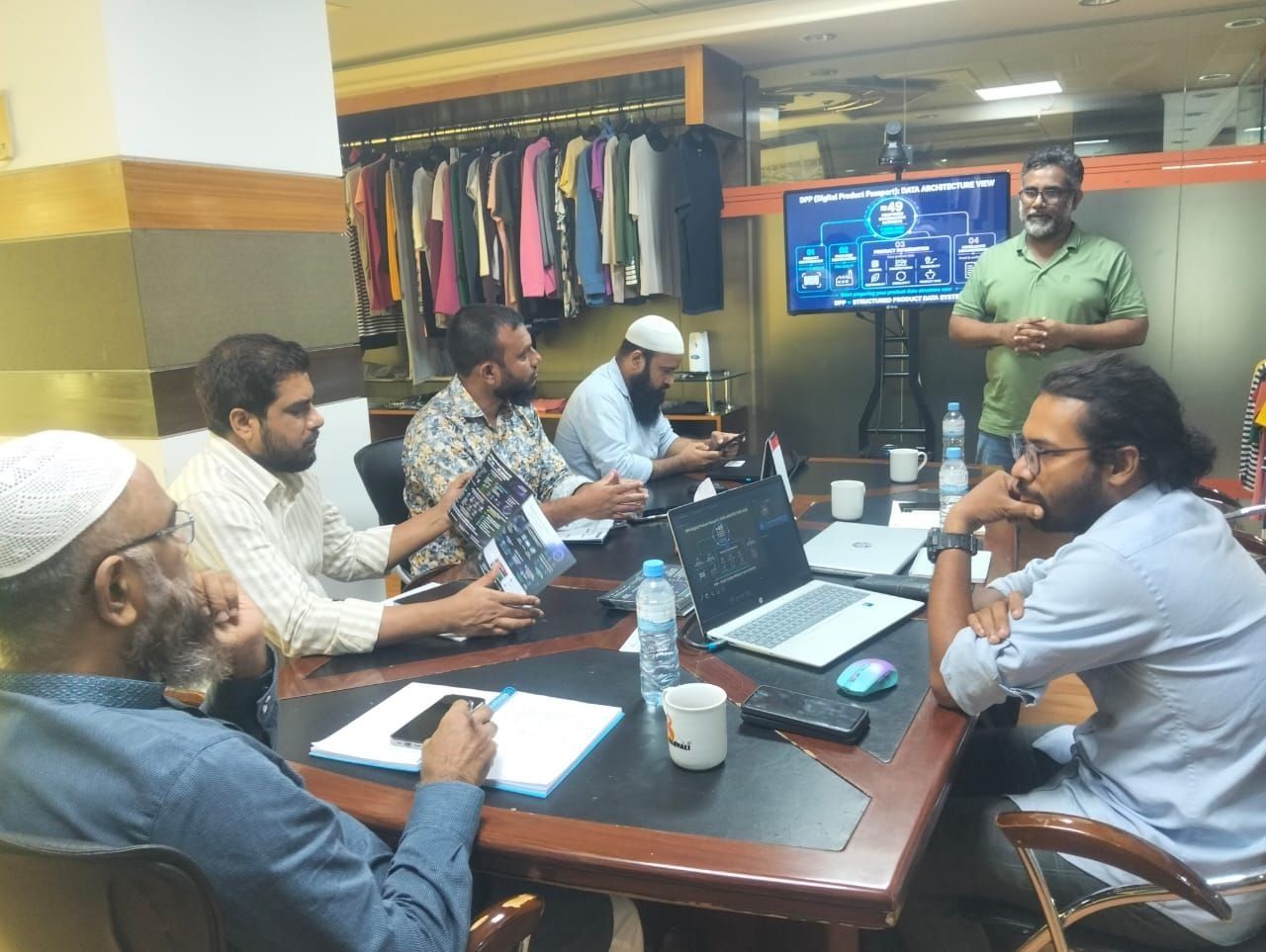
During a recent DeviceStamp meeting at Barnali Textile and Printing Industry (Pvt.) Ltd. in Bangladesh, the DPP conversation took place in an active garment business environment, alongside product samples and a working view of DPP data architecture. Rather than treating the passport as an isolated digital interface, the setting made the underlying question more concrete: how does information generated around a garment become a structured product record?

DeviceStamp meeting at Barnali Textile and Printing Industry (Pvt.) Ltd., Bangladesh.
The meeting is one example of a broader readiness process. Factories need space to compare the future DPP framework with the records they already use, identify where information comes from and see which relationships are currently maintained manually.
This kind of discussion is valuable because it moves the topic away from hypothetical data fields and toward existing workflows. The useful question is not whether a factory can produce a polished DPP demonstration. It is whether the organisation can explain how the underlying product information is created and kept current.
Five relationships worth testing now
Factories do not need to map every possible DPP field to learn where their current weaknesses are. Testing a small number of relationships on a real product can reveal much more.
- Product to material: Can each important component be tied to the correct material record?
- Material to supplier: Is the supplier reference clear enough to match records across organisations?
- Supplier to facility: When facility-level evidence matters, is the production or processing site identifiable?
- Evidence to scope: Can a certificate, test report or other document be linked to what it actually supports?
- Change to affected product: When a material, supplier or facility changes, can the team identify which product records need to be updated?
The value of this exercise is that every gap leads to a practical action. A material identifier can be mapped. Ownership can be assigned. Evidence scope can be captured more clearly. A change process can be connected to the product record. That is more useful than collecting a larger volume of documents without knowing how they relate.
Ownership keeps the record alive
Data quality can deteriorate even when the initial onboarding work is excellent. A product record may be complete when a style is first created, then become inaccurate after sourcing changes, certificate renewals or production moves. Maintaining the record therefore requires ownership.
The team that first receives a change is not always the team that maintains the DPP-related record. Procurement may know first that a material supplier changed, while compliance owns the relevant evidence and merchandising manages the product specification. A workable readiness process needs a defined path between them.
This does not require creating a separate DPP department. It requires deciding which existing function is authoritative for each important data element and how updates are passed to the teams or systems that depend on it. Without that responsibility, the same data may be collected repeatedly because nobody can be sure which version is current.
Good readiness testing uses normal products
A factory can learn more from one ordinary production style than from a perfect demonstration dataset. Choose a product with a realistic bill of materials and more than one supplier relationship. Trace its main materials and the evidence already used in normal quality, sourcing and compliance work. Compare identifiers across systems. Check whether current documents can be tied to the right supplier, facility or component.
The goal is not to prove that everything is already ready. The goal is to find where someone still needs to interpret, reconcile, or recreate the information. Those manual steps are useful signals. Some will remain legitimate human checks. Others indicate a missing relationship in the data structure. A manufacturer that understands that distinction has a much clearer starting point for DPP preparation.
The regulatory timeline should not become a waiting strategy
The European Commission's DPP Registry became operational in July 2026, while textile-specific requirements remain under development. Textile apparel is among the priority product groups under the ESPR Working Plan 2025-2030, with the Commission currently indicating Q4 2027 for planned adoption of the textile delegated act.
The underlying records serve existing business processes today. Better links between products, materials, suppliers and evidence can already reduce repeated data collection and make customer or compliance requests easier to answer. DPP requirements will add another reason for those relationships to be reliable.

Barnali Textile and Printing Industry (Pvt.) Ltd., Bangladesh.
The most useful preparation is therefore grounded in the way factories already operate. Start with real products, current suppliers and existing evidence. Find the handoffs that rely on individual knowledge. Clarify ownership before adding new layers of technology.
At DeviceStamp, we approach factory readiness from that operational starting point. The passport becomes much easier to build when the product record behind it can already be trusted and maintained.
Regulatory context
The EU Ecodesign for Sustainable Products Regulation (EU) 2024/1781 establishes the framework for Digital Product Passports. Textile apparel is included among the priority product groups under the ESPR Working Plan 2025-2030.
The European Commission currently indicates Q4 2027 as the planned adoption period for the textile ESPR delegated act. This timeline is indicative and may evolve as legislative and technical work progresses. The EU Digital Product Passport Registry became operational on 20 July 2026.
Official EU sources: