
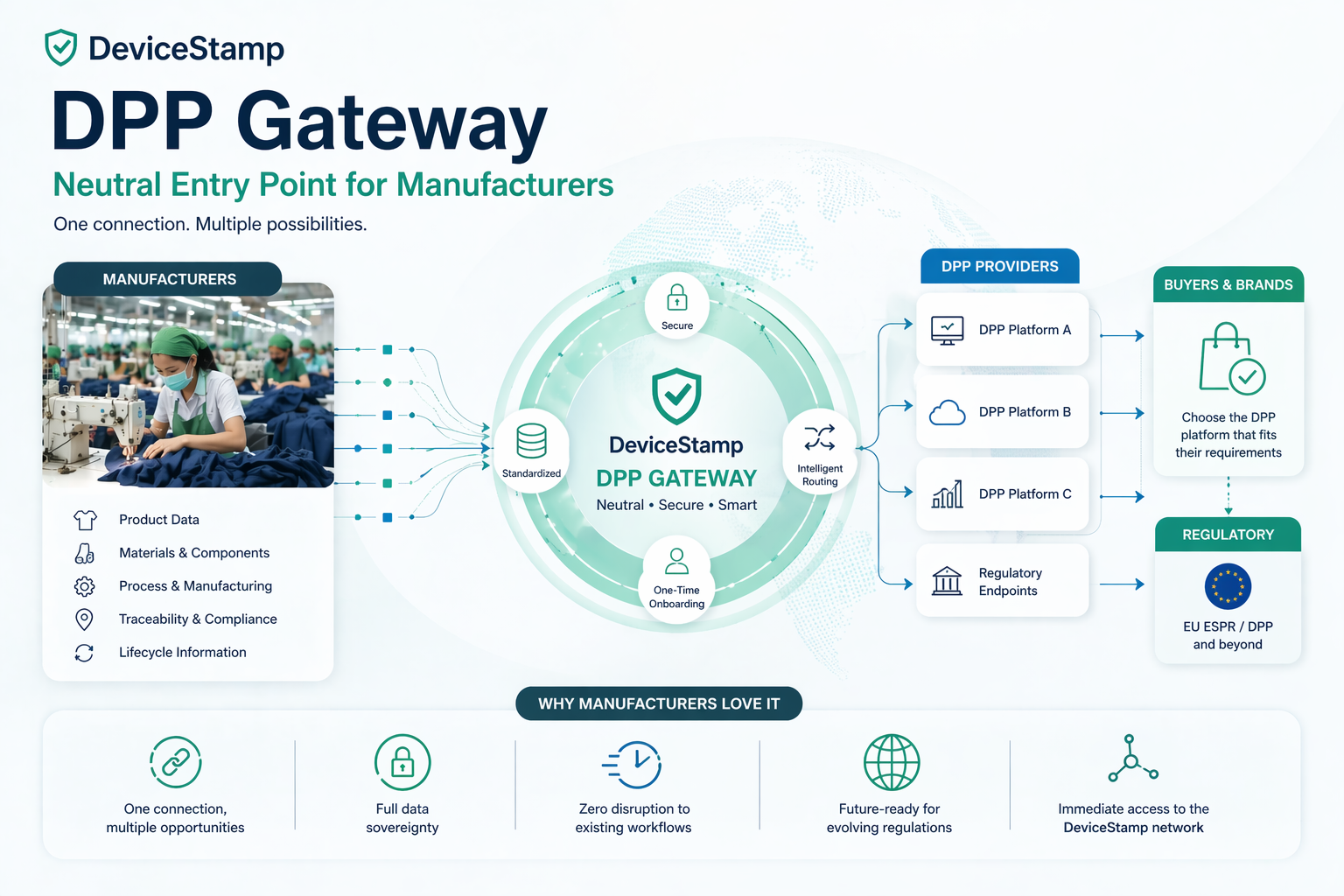
Rolling Out a Supplier-Side Gateway for Digital Product Passport Infrastructure
From Brand-Led Requirements to Supplier-Side Execution
Digital Product Passport (DPP) requirements are defined downstream by brands, regulators, and DPP solution providers.
However, the underlying data originates upstream at the manufacturing level.
This creates a structural challenge:
Factories are expected to deliver structured, product-level data across multiple systems without a unified integration layer.
DeviceStamp addresses this by deploying neutral infrastructure on the supplier side, enabling factories to connect once and serve multiple downstream DPP systems.
The Supplier-Side Infrastructure Model
The DeviceStamp approach does not replace or compete with DPP providers.
It enables them.
Core principles:
-
Single integration point for factories
Manufacturers connect once and can deliver data to multiple DPP platforms and brand systems. -
Vendor-neutral infrastructure layer
DeviceStamp does not act as a DPP registry, passport issuer, or compliance authority. -
Upstream data normalization
Data is structured, enriched, and validated before being transmitted downstream. -
Interoperability by design
Compatible with multiple DPP providers, standards, and evolving EU requirements.
Bangladesh as the Initial Deployment Focus
Bangladesh is one of the EU’s most critical sourcing regions for textiles and apparel, making it a high-impact starting point for supplier-side deployment.
The rollout focuses on:
- Direct factory onboarding
- Lifecycle data capture at source
- Integration with factory systems and workflows
- Preparation for multi-buyer DPP requirements
This is structured as infrastructure deployment.
Enabling the DPP Ecosystem
DeviceStamp operates as an upstream enabler within the broader DPP ecosystem:
- DPP providers define passport structures, compliance frameworks, and end-user interfaces
- Brands and retailers define requirements and consumption of DPP data
- DeviceStamp ensures that supplier-side data can be captured, structured, and delivered reliably
This separation ensures:
- No vendor lock-in for manufacturers
- Faster onboarding for DPP providers
- Consistent data quality across supply chains
Moving Beyond Fragmented Onboarding
Without a supplier-side layer, DPP adoption leads to:
- Repeated onboarding per brand or platform
- Competing or misaligned enablement programs
- Parallel reporting workflows
- High operational friction at factory level
The DeviceStamp model replaces this with:
- One integration
- harmonized enablement at source
- Reusable workflows
- Scalable deployment across factories and regions
The DeviceStamp Supplier Gateway
At the core of this model is the DeviceStamp Supplier Gateway:
- One-time onboarding
- Unified data interface
- Routing to multiple DPP systems
- Data validation and traceability layer
The Gateway does not host or replace Digital Product Passports.
It ensures that the required data reaches the appropriate DPP systems in a structured and reliable way.
Scaling Across Supplier Countries
Starting with Bangladesh, the model is being deployed with local onboarding, upstream integration, and global interoperability, with quick sheduled expansion to apparel supplier regions serving EU markets.
Positioning Within the DPP Landscape
DeviceStamp is not a DPP provider.
It is:
- A supplier-side integration layer
- A data normalization and routing infrastructure
- A bridge between manufacturing systems and DPP platforms
This positioning ensures alignment with existing and future DPP providers, rather than competition.
Preparing for Execution
As ESPR timelines approach, the challenge shifts from awareness to implementation.
Factories need:
- Integrated systems
- Clear data structures
- Minimal disruption to production
- Compatibility with multiple downstream requirements
Supplier-side infrastructure enables this transition at scale.
Contact DeviceStamp to explore factory onboarding or partnership opportunities with existing DPP platforms.