

The Future of Apparel Sourcing: Why Data-Ready Factories Will Move Ahead
Nirzhor Knitwear's work with DeviceStamp shows how structured product data, supplier evidence, and faster buyer responses are becoming part of sourcing competitiveness.
A familiar set of questions has traditionally shaped apparel sourcing. Can the factory meet the required quality? Does it have sufficient capacity? Can it deliver on time and at the right price?
Those questions remain essential. But another is becoming increasingly important:
Can the manufacturer provide reliable, structured product and supply chain data when a buyer requests it?
Digital Product Passport requirements are bringing this question into sharper focus. Product composition, origin, supplier evidence, chemical information and environmental documentation may already exist across a factory and its supply network. The sourcing challenge is whether that information can be located, validated and shared without weeks of manual coordination.
Nirzhor Knitwear Ltd. is preparing for that future before it becomes an urgent commercial demand. Through a practical pilot with DeviceStamp, the manufacturer is examining how its existing records, departmental responsibilities and supplier evidence can support a repeatable Digital Product Passport workflow.
This is not a theoretical exercise. It is implementation work taking place inside a working factory, with real records and real operational constraints.
A Manufacturer Preparing Ahead of the Market
Established in 2006, Nirzhor Knitwear operates 12 knit sewing lines and three specialised woven and denim trouser lines. According to information provided during the factory meeting, approximately 70% of its production serves the European market. The company exports around 3.36 million pieces annually, with an approximate value of USD 11.76 million.
For a manufacturer with significant European exposure, preparing for changing product-data expectations is not only a compliance consideration. It is part of protecting long-term buyer relationships and demonstrating that the factory can respond as sourcing requirements evolve.
Nirzhor is already working with DeviceStamp as a practical implementation client. Instead of waiting for a buyer to request a complete dataset at short notice, the company is using the pilot to understand what information it already holds, where the most important gaps sit, and how responsibility can be organised across departments.
That decision is what makes Nirzhor an important example for the wider apparel market. Early preparation creates time to solve problems methodically. Late preparation compresses the same work into a buyer's deadline.
From a Factory Visit to an Implementation Process
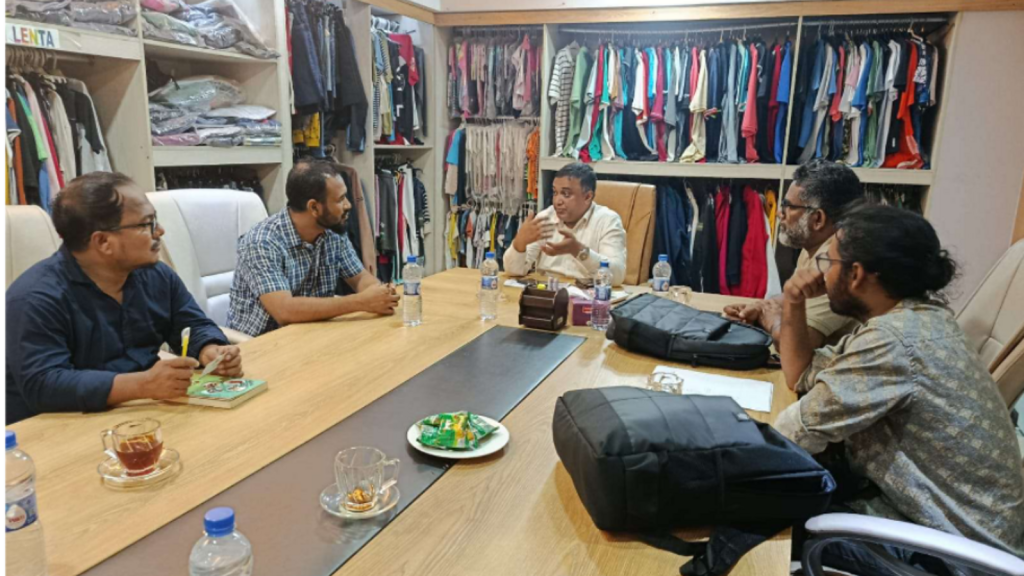
The DeviceStamp team travelled approximately 29 kilometres from Dhaka and arrived at Nirzhor at 8:30 a.m., during the factory's morning opening period. The programme began with an implementation meeting before moving across the factory's operational departments.
Nirzhor's HR, compliance, and merchandising representatives participated directly in the opening session. The factory team included:
- Mr. Kamrul, Head of HR and Compliance
- Mr. Rasel, Merchandising Manager
- Mr. Rabbi, responsible for European customer account management
- Operational colleagues from relevant factory departments
The DeviceStamp team was led by Md. Nazrul Islam, supported by Md. Ariful Islam Arif for industry engagement in Narayanganj, Jahidul Alam Mishuk as Project Manager, and Nurul Islam Khokon as production expert.
The discussions focused on how product, supplier, and compliance information is currently created, owned, updated, and exchanged. This people-centred view is critical. A Digital Product Passport is not produced by a single department. Its information may originate in merchandising, procurement, compliance, production, quality, and external supplier relationships.
The first implementation question was therefore not, “Which new platform should the factory buy?” It was, “How does information move through the factory today?”
The Real Sourcing Problem: Information Exists, but It Is Fragmented
Nirzhor does not currently operate an integrated ERP system. Important information is distributed across spreadsheets, certificates, departmental files, production records, and supplier communications.
This does not mean the factory lacks useful data. It means the information has not yet been organised around a repeatable Digital Product Passport workflow.
The pilot is helping Nirzhor and DeviceStamp establish:
- Which relevant information already exists
- Where each record or data point is stored
- Which department owns and updates it
- Which evidence is verified and reusable
- Which information depends on an external supplier
- Which fields are incomplete or unavailable
- How the information can be collected and maintained consistently
This distinction matters for the future of sourcing. Two factories may both possess the required information, but the factory that can retrieve, validate, and structure it quickly will create less work and less uncertainty for the buyer.
The Most Difficult Data May Sit Beyond the Factory
The opening stage of the pilot identified several practical challenges that extend into Nirzhor's supplier and subcontractor network.
Dyeing-house evidence
Nirzhor expects difficulty obtaining structured and timely information from fabric dyeing houses. Chemical, process and environmental evidence is not always supplied in a consistent format.
DeviceStamp's work is therefore focused on defining the minimum evidence required and testing a practical supplier-request process. The objective is not to demand every possible document. It is to establish which information is essential, how it should be requested and what evidence can support it.
Different levels of knitting-supplier readiness
Knitting suppliers do not all have the same digital or compliance capabilities. A data process that works for a highly digitised supplier may create unnecessary friction for a smaller source.
The pilot will examine whether standard forms, mobile-friendly submissions, document uploads and clearly identified supplier declarations can capture the required yarn, fabric, process and supplier information without imposing an unrealistic technical burden.
Printing and embroidery records
Printing and embroidery subcontractors may not maintain complete chemical-input and compliance records in a consistent structure. DeviceStamp is helping identify the essential fields, acceptable supporting documents, and a transparent method for distinguishing between information that is verified, supplier-declared, partial, or missing.
This classification is important. Data readiness does not mean presenting uncertain information as complete. It means knowing what can be proven, what has been declared, and where further evidence is still required.
Building on Evidence Nirzhor Already Uses
One of the pilot's central principles is that Nirzhor should not have to rebuild every dataset from zero.
The factory's experience with GOTS-certified organic textile production already produces useful records, including:
- Organic-fibre documentation
- Scope and transaction certificates
- Material-flow records
- Approved chemical inputs and Safety Data Sheets
- Subcontractor information
- Environmental-management records
GOTS and Digital Product Passports are different systems, and one cannot automatically substitute for the other. However, relevant verified evidence can potentially be reused where requirements overlap.
DeviceStamp is examining that overlap with Nirzhor so that the factory can retain credible existing evidence, avoid unnecessary duplication, and concentrate its effort on information that is genuinely missing.
This approach makes implementation more realistic. The goal is not to add another isolated reporting exercise. It is to connect existing factory evidence to a structured, maintainable product-data process.
What the Seven-Day Pilot Is Designed to Deliver
During the seven-day programme, Project Manager Jahidul Alam Mishuk is working across six functional areas within the factory. The pilot is designed to:
- Map required product and supply-chain data to its source and departmental owner.
- Review available certificates, production records and supplier evidence.
- Classify information as verified, declared, incomplete or unavailable.
- Identify priority gaps involving dyeing, knitting, printing and embroidery partners.
- Recommend a practical method for collecting, validating and updating information.
- Prepare a data-readiness assessment and implementation roadmap for Nirzhor.
These outputs turn Digital Product Passport preparation into defined operational work. They show the factory what it already has, what it still needs and who should be responsible for maintaining each part of the process.
Why Data Readiness Will Influence Sourcing Decisions
For buyers, sourcing risk is often created by uncertainty. A factory may have the right certificate or supplier record, but if the information takes too long to locate, cannot be connected to the relevant product or arrives in an inconsistent format, the buyer still faces operational friction.
A data-ready manufacturer offers a different experience. It can explain where product information comes from, distinguish verified evidence from supplier declarations, identify gaps early and respond through an organised process.
This does not replace quality, price, capacity or delivery performance. It strengthens them with an additional layer of confidence.
As structured product-data requests become more common, manufacturers that prepare early may be better positioned to:
- Respond to buyer questions without urgent internal searches
- Reduce repeated requests across departments and suppliers
- Demonstrate clear ownership of product and compliance information
- Reuse credible evidence instead of recreating reports for each request
- Identify missing supplier information before it affects an order
- Integrate more easily with buyer and Digital Product Passport systems
The competitive difference will not necessarily be between factories that have data and factories that have none. It may be between factories that can operationalise their data and those that cannot.
DeviceStamp's Role: From Requirements to Factory Workflows
DeviceStamp guides manufacturers from awareness to implementation. In the Nirzhor pilot, that means translating broad Digital Product Passport expectations into specific questions of data ownership, evidence quality, supplier participation, and departmental workflow.
DeviceStamp is not asking the factory to abandon its existing tools or introduce complexity for its own sake. The work begins with the factory's current reality: the records teams already use, the evidence suppliers can provide, and the points where information becomes difficult to access or verify.
From there, DeviceStamp helps establish a structured route from existing operational data to interoperable, buyer-ready information.
For Nirzhor, the immediate result will be a clearer view of its current readiness and a practical roadmap for improvement. For the wider market, the pilot demonstrates what preparation can look like before Digital Product Passport requests become routine sourcing conditions.
A Practical Example for Other Manufacturers
Nirzhor's advantage is not that every answer is already available. Its advantage is that the factory has chosen to examine the questions early.
By opening its processes to practical assessment, involving the people who manage the information and working through real supplier constraints, Nirzhor is building knowledge that cannot be created through a last-minute document request.
Other manufacturers can follow the same path:
- Begin with the records already used in the factory.
- Map each relevant data point to a department and owner.
- Separate verified evidence from declarations and incomplete information.
- Identify where external suppliers create the greatest gaps.
- Build a process that can be repeated across products and buyer requests.
The future of apparel sourcing will still depend on making the right product, at the right quality, cost, and time. But increasingly, factories will also need to make the product's information available with the same level of discipline.
Nirzhor Knitwear is preparing for that future now—and showing how an apparel manufacturer can move from scattered evidence to structured readiness with DeviceStamp as its implementation guide.
Prepare Your Factory for Buyer Data Requests
Is your factory ready to respond when a buyer requests structured product and traceability data?
DeviceStamp helps manufacturers map existing evidence, identify priority gaps, and build practical Digital Product Passport workflows around real factory operations.
Contact: onboarding@devicestamp.com